By Alejandra Ocampo
September 1 1939 marked one of the most horrific dates in human history – the commencement of the tragic Second World War; a devastating conflict that claimed million lives, masses of destruction and years to recover across Europe, after it was over, in 1945.
Normal life had to be put aside, and this included sports activities; polo was one of them. Like in the First World War, several officers were called to serve. This implied the loss of many players, as well as those badly injured. But once the tragedy came to an end, the dawn of a new life, a new era, was expected, although it wouldn’t be an easy task – life was a daily struggle, rations lasted for many years and the whole Europe had to be re-built as a consequence of the horrific nazi bombs; England took, perhaps, one of the worst parts, as the country was constantly bombarded by the nazi riots, known as the “blitz”. However, the English people, under the command of His Majesty King George VI and Prime Minister Winston Churchill, remained determined to carry on with their lives, and faced those horrific times at their best. We could say that something similar happened to polo, once the war was over.
Much of the polo played it England took place at the magnificient Cowdray Park Polo Club. Founded in 1910, and considered the home of British polo, the club’s distinctive feature are the extraordinary ruins of the Cowdray Castle, that gives the perfect backdrop to the main ground. The castle, built between 1273 and 1284, saw the Tudor splendors in the 1500s, receiving visits by King Henry VIII and subsequently, his daughter, Queen Elizabeth I. The ruins we see today are a consequence of a brutal fire produced on 24 September 1793. The massive flames that swallowed the castle, made it impossible to be brought back to his previous splendor, so the ruins remained. In the XX Century, when polo stopped due to the Second World War, Cowdray Park Polo Club was occupied by the Royal Army Service Corps, and the fields were ploughed for agricultural use and parts of the grounds repurposed for military training by the Fleet Air Arm.
But in 1947 a determined man became crucial for the return of polo in England – Weetman John Churchill Pearson, Third Viscount Cowdray, and the major force behind the revival of polo in England after the horrific war.
Pearson, born in 1910 – on the same year Cowdray Park Polo Club was established – was a polo player himself. A Territorial Army officer who rose to Lieutenant Colonel, he suffered severe injuries at the Battle of Dunkirk, in 1940; as a resut, his left arm had to be amputated. But as determined as he was, John Pearson wasn’t about to give up the sport he loved. Pearson adapted to resume playing through a specially built artificial arm, that helped him to seize the reins; he played until past 70-years-old. In the meantime, and while resuming his playing, he assembled a string of approximately 20 polo ponies, which was one of the largest strings of polo ponies in the United Kingdom by the late 1940s. In addition, he loaned horses to other players, in order to encourage more participation and contribution to the re-birth of all things polo in the United Kingdom. A constant and tireless visionary, he travelled to Argentina for the first time in 1949, as a captain of an English Team, following an invitation he received by some Argentines who visited Cowdray in 1948. This event marked a significant milestone in post-war recovery for British polo; Pearson made a second trip to Argetina, in 1951, when he found more horses and got players to go to play at Cowdray.
Competition at Cowdray was officialy back in 1953, with one of the first major tournaments after the war, the Coronation Cup, that was attended by several spectators, including members of the Royal Family. But Pearson went further. He saw potential, he saw the club was ready for more.
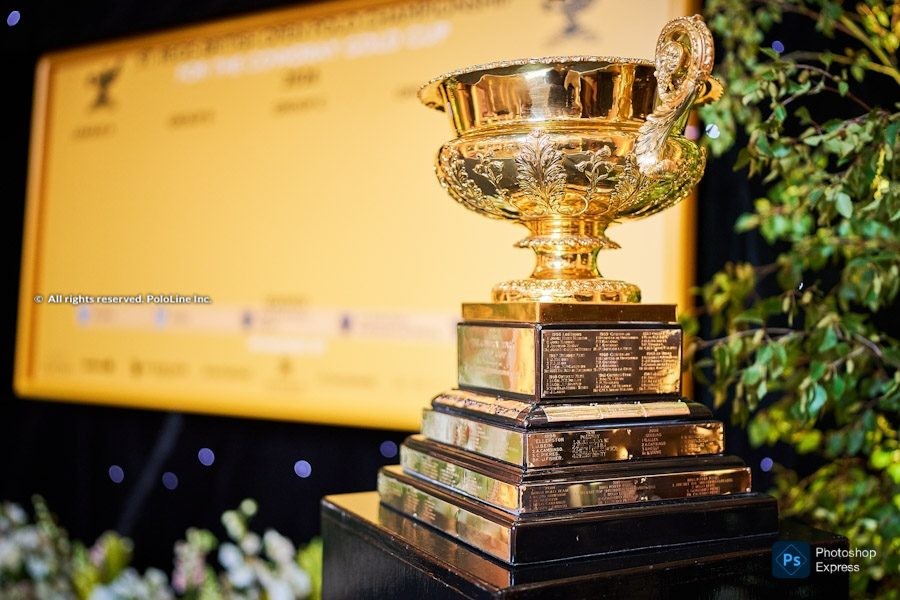
In 1956, exactly 70 years ago, John Pearson established the Cowdray Park Gold Cup, also known as the British Open, a tournament that positioned the club as the epicenter of high goal polo not only in England but also in Europe, as well as a solid global reputation – the club founded by the Pearson family in 1910, suddenly became a premier venue, thanks to Pearson’s hard work, vision and perseverance. His commitment not only restored local infraestructure, but also competitive standars, with the British Open Polo Championship for the Cowdray Gold Cup as the jewel of the crown, and the highlight of the season in England.
The first team to ever win the first Cowdray Park Gold Cup in 1956 was Argentina’s Los Indios, made of Jorge Marín Moreno, Pablo Nagore, Antonio Heguy and Juan Echeverz. It’s worth to notice that Antonio Heguy’s legacy would continue with his grandsons, all of them winners at Cowdray Park. The first to make it were Eduardo and Ignacio Heguy, in 1996, with CS Brooks; they were followed by Bautista Heguy, in 2000, with Geebung, a lineup that saw him playing together with no less than Adolfo Cambiaso. The last member of the legendary Heguy family to claim a Gold Cup was Marcos Heguy, in 2004, with Azzurra.
But from 1956 onwards, the tournament has produced countless memorable moments and remarkable records throughout its history.
- Only three women have ever won the Gold Cup – Nina Clarkin (Hildon Sport, in 2003); Kayley Smith (UAE Polo Team, in 2023); and Mia Cambiaso (La Dolfina Scone, in 2025).
- The tournament recorded its largest-ever entry in 1990, when an extraordinary 22 teams competed for the title.
- To date, only two all-British teams have won the Gold Cup. The first was Windsor Park in 1969, featuring Lord Patrick Beresford, Marquess of Waterford, Prince Philip and Paul Withers. The second was El Remanso in 2018, with Charlie Hanbury, Ollie Cudmore, James Beim and James Harper. And there’s more – James Beim and James Harper have been victorious twice. In addition to having won with El Remanso, James Beim made it in 2018 with Ellerston White, and James Harper was victorious in 2021 with Thai Polo NP.
- Many British lineups composed by aristocrats or royalty, such as Lord Patrick Beresford or the Marquis of Whiteford who played the Gold Cup. But the most famous of them all was no less than His Royal Highness Prince Philip Duke of Edinburgh’s Windsor Park. With his team Windsor Park, he was persented with the British Gold Cup three times – 1957, 1966 and 1969. The 1966 lineup included the remarkable Gonzalo Tanoira, whom the Duke of Edinburgh deeply admired and became a great friend. He nicknamed Tanoira “Speedy”.
- The Hon Mark Vestey, Nina Clarkin’s father (she took her last name after her marriage to New Zealand’s born player, John-Paul Clarkin), is among the British who claimed the tournament many times times – a total of four titles with Stowell Park, in 1973, 1974, 1978 and 1980.
- One of the most innovative players of history and a man who contributed a great deal with British polo, has a very well deserved place within the prestigious tournament’s history – Eduardo “Gordo” Moore. Moore has a record of seven wins – six with Stowell Park (1973, 1974, 1976, 1978 and 1980), and one with Foxcote (1977).
- The legendary Héctor “Cacho” Merlos – winner of the Argentine Triple Crown with Santa Ana, in 1973 – was victorious in 1981 with Falcons. Years later, his sons Sebastián and Juan Ignacio “Pite”, would give a Gold Cup to the Merlos family, back in 2007 with Lechuza Caracas. It is remembered as a very tough contest, with Pite leaving the field due to an injury, and had to be replaced by his youngest brother, Agustín.
- The Pieres family has left a mark in Cowdray Park. Gonzalo Piere won the Gold Cup in 1979, with Shongai, in a lineup that included his brother, Alfonso. He would repeat in 1981, with Falcons; Ellerston White and Ellerston, in 1995 and 1998, respectively. The latter saw him playing with Adolfo Cambiaso and James Beim, whom he won the Queen’s Cup with Gonzalo’s younger son, Nicolás, in 2019. All of Gonzalo’s sons would be champions as well, both together or by separate ways. The first time two Pieres brothers won the Gold Cup was in 2009, with Gonzalito and Facundo victorious with La Bamba de Areco; that before earning such a great achievement, when they lifted the trophy for three consecutive years, 2015, 2016 and 2017, with King Power. Facundo would become a champion on his own, playing for Zacara in 2013. And the youngest brother, Nicolás, was successful in 2021 with his Thai Polo NP.
- The Novillo Astrada family have their name carved in Cowdray Park. It all started in 2002, when Eduardo Jr., Javier and Alejandro were victorious with Black Bears; Alejandro won the golden trophy one more time in 2004, with Azzurra, while Eduardo Jr. and Javier would make it two, as well, in 2006, with Black Bears. However, the unforgettable Javier was also a champion on his own, as a member of the Labegorce foursome, in 1997, that included Carlos Gracida.
- It’s precisely the unforgettable and legendary Carlos Gracida who holds the record for the most Gold Cup victories – he lifted the coveted golden trophy no less than an astonishing 10 times.
- Most recently, the Castagnolas also have significant achievements in Cowdray Park. Lolo Castagnola claimed the Gold Cup in 2001, with Dubai. The same team, Dubai, would see his sons, Barto and Camilo, as the winners in 2019.
- The youngest player ever to win the Gold Cup was Poroto Cambiaso, who claimed the title at just 14 years old in 2020, playing with his father in Jean-Francois Decaux’s Next Generation. In addition, Poroto surpassed the previous record held by his father, Adolfo Cambiaso, who was 16 when he won his first Gold Cup.
- Speaking of Adolfo Cambiaso, he is also the only player to have won the Gold Cup alongside two of his children – with Poroto for Next Generation in 2020, and with Mia for La Dolfina/Scone in 2025, making him a current title holder.
- Dubai Polo Team are the tournament’s most successful team, having reached a record 11 finals and secured the Gold Cup on six occasions.
- The 2025 tournament was one of the most exciting on record, with an incredible 876 goals scored across the competition.
But ahead of these records and stats, the truth is that Cowdray Park Polo Club has a remarkable significance for polo. Today, the Cowdray Park Gold Cup, the British Open, the Gold Cup, the Cowdray Gold Cup, the British Open Polo Championship for the Cowdray Gold Cup, will be run under the name of St. Regis British Open for the Cowdray Gold Cup or short, St. Regis Cowdray Gold Cup; watever the name given, the competition that presents the utterly magnificient golden trophy to the winners, is celebrating a remarkable milestone, 70 years; 70 years of a one-of-a-kind and highly competive tournament, that became one of the most remarkable polo tournaments worldwide as well as being named as one of the three Grand Slams of Polo, alongside the Argentine Open and the US Open. 70 wonderful years of a historical contest that was made possible by the unique and exceptional vision, hard and tireless work, and commitment of Weetman John Churchill Pearson, Third Viscount Cowdray, the man, the heart and soul behind the re-birth and the revival of polo after the devastating Second World War.
Cover photo by Mark Beaumont.