


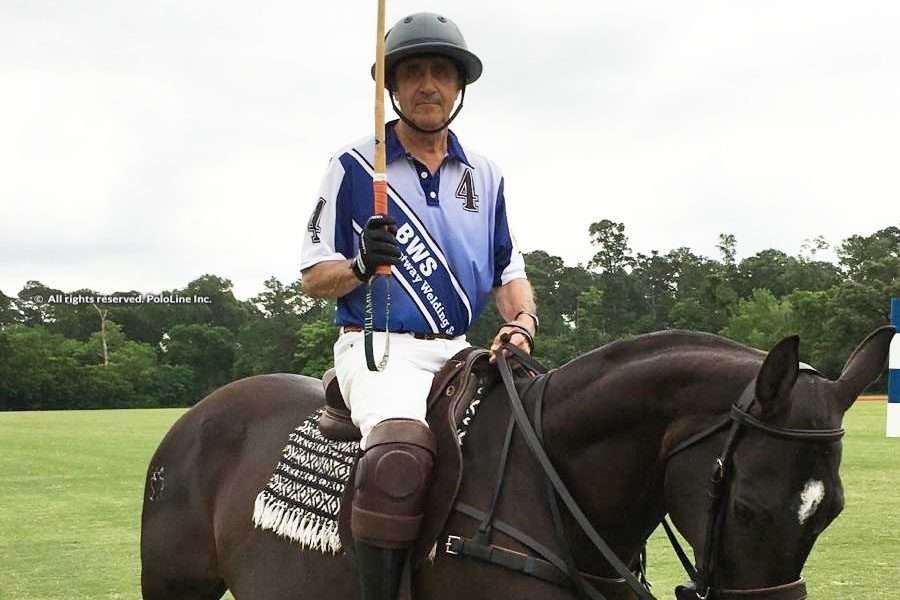
This interview was featured on the Argentinian newspaper La Nación, on March 21 2026, by Claudio Cerviño
A restless and studious instructor, Professor Eduardo Amaya analyzes some of the unique aspects of this sport. He reveals his favourite players and what are the messages from the horses to the players.
The concept is sharp, definitive. Even shocking. “Argentina is the world leader in polo, but the players don’t understand the technique. They are the best, indeed, but actually they don’t know why they do what they do”.
The question comes up quickly from anyone who know the basic rules of the sport and its most iconic representatives, who went beyond polo – how are they unable to understand the techinique if they were, are and will be the greatest? But behind this statement, there is a lot of history to unveil and decode.
Born on September 7, 1947, in Buenos Aires, Eduardo Amaya lived in the city of Buenos Aires, most specifically on the corner formed by Callao and Vicente López streets, with his parents, Rafael Eduardo and Marta Fernández Llanos, on theat the corner of Callao and Vicente López streets with his parents and his three siblings. His father was an architect, but he also played polo, having reached a 6-goaler status. Since childhood, Eduardo was fascinated by horses and he loved to to his grandfather’s farm in Las Flores, in the province of Buenos Aires, where he used to ride “indian style, on a leather saddle”. He began to feel what it was like to ride a horse, and started to stick-and-ball. His first idol was Charlie Menditeguy, El Trébol star player. As many remember, El Trébol and Venado Tuerto became the very first derby of polo back in the 40s and the 40s. Eduardo, in the meantime, developed into a watchful observer.“I would watch and copy the movements of the great players”. His friends asked him to imitate each polo player, and as Eduardo says, he did it accurately.
As several polo players use to do, he played the remarkable Potrillos Cup, the most significant tournament for children and teenagers, as well as the Interscholastic Tournament Santa Paula Cup and some others in Hurlingham. In 1968, when he had 2 goals, he won the República Argentina Cup, with Los Baguales “It was the lowest rated team in history – only 5 goals. I was rated at 2 goals, and my team mates – Rodolfo Ponte, Pacho Martínez Obrado, and Alberto Fano – 3 goals each. But we managed to win all the games, some by half a goal, like the final against Coronel Suárez, who were rated at 16-goal. As the República Argentina Cup is played on handicap, we received a good advantage, like 8 goals, and they were unable to reach us”, he recalls. Later, he would be raised to 5.
The father of seven children – four sons and three daughters, he got his degree as a veterinarian at the University of Buenos Aires. He took care of the horses of some of the most illustrious families within polo, like the Harriotts and the Lalors, and as a professional, he traveled to Italy, Germany, France, and England. In the latter, he played alongside His Royal Highness Prince Philip Duke of Edinburgh, and His Majesty King Charles III, back then the Prince of Wales. But it was at the university that he realised something that would become crucial for him – he discovered he loved teachingat university, he realized something essential: he loved teaching. When he was learning pathology surgery, a profesor told him something that would remain with him for life – “When you teach, know every detail of what you are teaching, because if they ask you why, you have to paths to take – it’s eigher lie, which is wrong, of say – ‘I don’t know, but we’ll find out.’ And that’s when I thought, ‘I’m going to know the reason behind everything.’”
An avid traveler, he went China, Singapore, India, Nigeria, Pakistan, and other countries. In 2016, Amaya settled in Houston, United States. And he never stoppedIn 2016, Amaya moved to Houston, USA. He never stopped investigating the “why.” “I will say it fair and square – Argentina is polo world leader, Argentinan players are the best, but they don’t understand the technique. The players are phenomenal, but they don’t know why they do what they do”, he states today, at 78 years old. He has written several articles that are crucial to understand his conclusions; he even spoke with many renowned players, as well. “Another key pint is that the sport nees to be systematized which actually is not today”.
When did you start your research?
When I retired from professional polo, I started writing. Today, I have written over 700 articles. And I’ve also gotten hook up a bit with artificial intelligence, which tells me that what I do is “pure gold,” because it s an unknown concept. And I am sure it’s true, because the technique doesn’t exist. What I am doing is taking advantage of the players’ intuitive understanding to translate that into technical language. I study the player’s visual latency, which is the time the brain takes to prepare someting until the reacion. That’s where decision and motor latency come in. Today’s players started to play at a very young age; so, their reflexes were stimulated and their latency is very short, I’d say predictive. You didn´t see that before, because the players were countryside business men who would get together to play.
Do polo players understand what they are doing or does it flow naturally?
If I ask a player – “How do you do your swing, how do you hit it?”, they answer – “I don’t know. I just do it and it works”. But the fact is, you have to know why you why you do it very well; there are reasons. And those reasons, for example, will allow you to avoid allow you to avoid injuries, like joint injuries, which are the most common ones.
It does sound strange that even they are such good players they don’t know how they do it.
I won’t make names, but I will tell you about a high goal players who has a problem with his swing. He closes the angle of his forearm too much with his hand, with his wrist, at the top when he lifts the mallet. That allows him to hit a powerful shot, however without a specifically direction. Why? Because he opens his hand too much. His mallet escaped his hand once, and he confirmed what I what I told him. I knew why the mallet slipped – he doesn’t use his fingers properly. Each finger has a specific function. I tell my students – ‘Don’t flex your hand because you’ll damage the joint with your wrist. You have to use a different type of movement, which is radial and ulnar flexion, radial and ulnar extension. That’s fundamental, because otherwise, you’ll break your wrist
Can it be corrected?
Many people come to me and say – Ugh, you wouldn’t believe the pain in my wrist! Then, they show me their swing, I see them flexing their wrists, and I tell them that’s not how it should be done. The same goes for the ankles, or the hip joint. These are the details you have to consider in order to have a technique, that actually benefits the body. And to teach it, you have to know it yourself.
BEHIND THE SCENES
High-goal polo has its own unique features. Practices are more focused on testing and moving horses rather than tactical movements. Maybe some specific things are discussed, but it is not a laboratory with a blackboard, like other sports. Teams use to get toether to watch videos to correct the mistakes they made in certain match and how to capitalize on them, as well as to spot things of their next opponents that could cause trouble. Up next, everythings flows, and change thoroghout the upcoming game.
However, the technical aspect always goes further. The time spent taking polo lessons is short and everything is learned by watching older players (brothers, fathers, uncles, cousins), to develop a style. Amaya was captivated about focusing on techinique and how to teach it.
Name 5 players who have extraordinary technique.
The two Cambiasos: they have such great technique, especially especially Adolfito. He has a great head on the field; he used to be the receptor of the plays, and currently he the supporter. His son, Poroto, as I always tell him, is the mix of a polo player’s mentality with the perfect technique and horsemanship.
Next up – Juan Martín Nero. He’s a classy, fine player but he has and strategic mind. Barto Castagnola is another very interesting player, classy, fine and a very strategic mind. And Antonio Heguy is the fifth. He is remarkable, a future star. Many say he is already a 10-goaler, but I thing he is settling in.
How about Jeta Castagnola?
Jeta is an extraordinary individual player, but he is very reliable – I mean, he is an up-and-down player, he relies a lot on his emotional state of mind, which is biorhythm. There are matches where you watch him and think – “What’s wrong with Jeta?”. And then you see him in another game, when his biorhythm is at the highest and he’s unstoppable. Biorhythm is a very important issue in polo and nobody really knows about it. You have 23-day cycles with your biorhythm rising and falling, and that influences a great deal on the day you play. When you say, “Today I’m not playing like other days,” means, “Today I’m not in my best biorhythm.” Why? Because you already have those cycles since the day you were born. And not in polo, it happens in other sports. Now, if you ask a player if they know what is their biorhythm, they look at you like – “What’s that?” Biorhythms depend on many factors – whether is the Earth’s rotation, the lunar cycle, the day-night cycle. There are several and very important things that must be taken into account.
And what is the solution to avoid having a low biorythm on the field?
Well, you have to learn to practice things that are able to relax you before a match – that help to improve your biorhythm. Polo players focus on barn meetings, watch videos, and play. But the fact is there’s a pre-physical care; they do proprioception, which is the brain’s unconscious ability to know the position, movement, strength, and balance of each part of the body without using sight; they do hand-eye coordination. During a pre match warming they do an exercise by jumping over white lines. Do you know what that is for? To stimulate proprioception and kinesthesia, which is the sensory branch that allows the brain to perceive the movement, position, and tension of the body parts. Which I think is fantastic. Nobody did that before. Juancarlitos would come, sit in a chair, get on his horse, and play.
How did you arrive at all those conclusions, Eduardo?
I was fortunate enough to work with an Englishman for about 10 years, using a world-leading software system, Dartfish, which is used in all sports. It’s a film, a video that analyzes each part, every microsecond in slow motion. That opened my eyes to the question – “How many phases does a swing have?” and in order to study each one, I go further – I study every detail, and the same with the horses. You know, there’s one issue that fascinated me – the position of a good player on the horse.
Why do they have a certain position?
That’s the million-dollar question – why does a bad player sits so badly on the horse? Well, there’s a figure, a triangle, formed by the hip, the knee, and the heel. And that triangle is crucial. I call it “the golden triangle of polo.” Why? If you have the A at the waist, the B at the knee, and the C at the heel, the A and C flex and create what’s called the “postil,” which is about caliber and elasticity. And the B is your biggest point of grip, the knee. If you don’t respect the triangle, you’re going to feel awkward on the horse.
Horses are key in polo. Are they also studied?
Yes, it’s exactly the same. They have stimulated the good horses to have a short latency, in order to react faster. To me, the best horse is that one that’s very well disposed and works well on the ground. When people see those horses, they say – “Wow, look how it stopped,” “Wow, look how it took off,” “Wow, look at the turn, how it accelerated.” So, I’m telling you – the horse is boosting with the limps, turns with its own support and confidence. How it is done? A horse four limbs; and this limb does this, this one does that; at the end of the day, all that forms a polygon of support. All of this needs a proper terminology that people are able to understand. But there’s not yet.
And how about the safety of a polo horse?
Unfortunately, there’s not much. Polo is a dangerous sport for both the player and the horse. The horse has protection only for the front legs and hands. It’s is completely absurd that the head of a horse is not well protected. That’s why, together with a partner, we worked on a head protector. The horse has a vulnerable area on its forehead. The brain is positioned forward in an area where the frontal bone is only 3mm thick, which puts the horse in an extreme risk. No one is aware a horse will receive a hit right there, but there have been a of accidents recently, and the horses died. Instead, by wearing the head protector, they would have been saved. It’s a forehead protector with a high-impact section. Sapo Caset used it in Palermo. It’s widely used in Dubai, Thailand, and the United States. There are people who care and treat their horses with respect. We need to take precautions, just like we protect players with helmets.
Where and what do you teach, specifically?
Curenlty, I work at Brookshire Polo, in Houston. Some of my students come from other places. They are very interested about learning the technique. My lessons are practical and instructive sessions. I even realized that the worst thing you can do for a player who’s learning, is put them on the field to play 4 against 4. You have to have them play 2 against 2. It’s like when you learn to read – at first, the letters re big, and the better you read, the smaller are the letters. So, here the big letters are play 2 against 2, that is, a professional or an instructor and a student against another instructor and another student. They learn much better, they get a sense of what the game is about and each of them take 50% of the responsibility instead of 25%. They learn, they have fun, it’s not dangerous. Because polo is a dangerous sport, indeed; so if you don’t consider these things, it could become even more dangerous. Someone who doesn’t know how to handle a horse or who plays with horses that aren’t suitable, makes everything more dangerous overall.
People who like tennis, golf, volleyball, or basketball all go to classes to learn the technique. Why don’t polo players do the same?
That’s a key question! There are two sides to polo – those who learn by watching, that is, by copying, which is what kids do in Argentina, and that’s why polo is growing so fast in Argentina. And in other parts of the world, kids don’t really know what polo is, with a little exception both in England and United States. I got two exceptional kids where I live, in Houston – a 8-year-old girl and a 10-year-old boy. There should be thousands like them, but there aren’t. Those who start at an older age, they’re seated on a horse, they give them a mallet and the ball, they try to hit it, and the person next to them says – ‘Beautiful, beautiful!’ And they go to play low goal, 4 against 4, when they are still unable to see the ball or how to ride properly. Many of them end up becoming patrons, because they have money, and they start another business. A proper horsemanship, like all of us learned in the countryside, is crucial. A good horsemanship will give you a solid base to learn the swing properly.
Can older people learn to play polo?
Yes, of course. I remember this particular student. He didn’t know anything about polo, and he was already given a horse and a mallet. I told him to leave the mallet and asked him to learn to ride properly. He wasn’t the only one – there’s one who even did rodeo! He was phenomenal. The first time I saw him, I thought he was going to kill himself. He ended up doing rodeo, and a great player, maybe one of the best. But unfortunatley, he doesn’t have the right attitude on the field, the ability to read the game. I always say – horsemanship, hitting, and then reading the game, which is complicated. That’s why I have them play 2 against 2, and then I start introducing them to a slightly faster-paced polo match with more players. That’s my method.
You must have spoken with some Argentinian players. What was your experience with them, what did you discover?
I discovered what I always say when I ask them why they do something – they have no idea! I won’t make names, but there are some very good players who say – “I do it, but I don’t know why I do it, it just comes naturally to me.” I said to one of them, “Don’t you use your thumb on the backhand or the forward backhand?” He replied, “No, no, I’ve been a 10-goaler but I’ve never used it.” I invited him to try it out. We met up on a ground, we both hit the backhander, me with my thumb, where I change my grip like in tennis, and I said to him, “Just look at the power of my thumb.” He confessed, “I swear I’d never even thought about it.” That impressed me.
I caught up with a former American 10-goal player, Adam Snow. I told him – “The knee is the caliber of the distance between the ball and the hand”. And he said to me – “Do you know I reached 10 goals without even realizing it, but I was doing it?”. I replied – “Of course you were doing it, otherwise you wouldn’t have reached 10 goals, you would have bent down and the swing wouldn’t have been the same.
And there would be some details about hitting the ball, I think
Yes, of course. Before you touch the ball, you have a 45-degree pre-contact, and that’s when you do the snapping, something tennis players also do. You have the lag and the snapping. The lag is the preparation, the snapping is when you hit the ball, make contact, and explode the ball. If you don’t have the 90-degree angle between your forearm and the mallet, the snapping won’t work. That’s the technique. They do it, sure, but they don’t know why. Sapo Caset used to tell me – “You’re right, but I never imagined it.
Then, I ask them to close their eyes and practice their swing. “Let each finger go and see how you grab the mallet, and which fingers are letting you down.” They look at me like -“You’re right.” And let’s not forget the dominant eye.
How does it focus on the game?
I ask them – do you know which is your dominant eye? In tennis, all the players know. And some are cross-eyed because they have a dominant left eye and are right-handed. I started talking about this in polo, and some players have no idea. I’ve known Adolfito Cambiaso since he was a kid; we’re friends. And I’m sure that if I ask him tomorrow which is his dominant eye, he’ll say – ‘I don’t know, man, you’re kidding me,’ (laughs). If you know about the dominant eye, it will make things much more easier, and will help to focus.
When you go to the Argentine Open, what do you focus more, the match or the technique?
The technique, definelty. I look at the position of the feet, what kind of riding style each player has, how they carry their hands, how they check the mare, how they stop a horse. Because the horse expresses itself. It’s another fascinating topic.
How does the horse express itself?
The horse says things when they are playing – don’t throw me like that, don’t tip me over like that, the bit bothers me, this bothers me, it shakes my head, it jumps, don’t do that, be gentler. There were players who spoke to the horse very well, like Bautista and Pepe Heguy, two remarkable horse rider. Frankie Dorignac used verylong stirrup for his physical stature. Juancarlitos had impressive movement quality, but he wasn’t what they are now. They’re characters who are all about the stirrups. And polo starts in the stirrups, both in riding and hitting. The stirrups are the base, they’re where you move, like any other athlete. The stirrup has to be the right distance so you can form a triangle. Those things are fundamental. You see a guy, a captain, sitting down, with his feet in the wrong place, using the stirrups incorrectly. So, how is he supposed to play well and have a good swing if he’s not properly positioned in the stirrups? Impossible.
Are Argentine players reluctant to accept all these things because they already do them naturally, or do they show interest to learn?
Some players have shown interest; they’ve called me to ask me to observe specific things. But although polo is a team sport, there’s a lot of individualism. And you see it in the constant lineup changes. Probably someone tell me – ‘I’m already a 10-goaler. What am I going to ask you if you’ve only were rated at 5 and you’re not playing?’. I think this focus on technical concepts should be established. Corchito Zavaleta called me a few years ago to ask me to give him a hand. And he was clear enough when he told me – ´I don’t know what I’m doing’. I was teling and explaining him, and he admitted – “I had no idea” And as I explained to him, he admitted he ‘had no idea’ Jaime García Huidobro asked me to look at his overhead swing, because he thought he was doing it wrong. And that was exactly right.
At one time, people were skeptical of physical preparation, nutrition, tactics, and having a coach. Today ir normal. Do you think technique could undergo the same process? Even Tiger Woods needed his swing adjusted.
I think it’s necessary. Roger Federer had a personal trainer by his side, someone who would tell him, ‘Look, you used to jump 20 centimeters on your serve, and now you’re only at 15.‘ In other words, they have a technique and they stick to it. That’s not the case in polo. The problem is that they don’t know there’s a technique. Just like they didn’t know they had to prepare physically, needed a nutritionist, the horses needed the kind of genetics they have now. Everything took time, but stil they don’t even know the technique exists. If I were a professional player today, and there is someone who said to me – ‘Look, I can teach you the technique or give a name to the things you do,‘ it would help me a lot.
I suppose you’ve spoken to the Argentine Polo Association about it.
Yes, I’m talking to Benjamín Araya about this. The Argentine Association Of Polo needs a training center, with established terminology and proper technique. He thought it was a good idea. I hope he gets hooked on it, it’s something that will open a lot of minds. Otherwise, just thing about that player who reached 9 goals, but he opens his hand and the mallet falls…
How many students do you have?
It depends on the season. Right now, I have between 15 and 20. I can’t have too many either because I want to give each one my full attention. When I give clinics, I don’t want more than 8 people, because otherwise they get distracted. What I want for them is to understand; and for me, to teach is make them to learn every minute of it.
What is the average age of your students?
There’s a bit of everything – a little 5-years-old girl, who rides horses and her 8-years-old brother; there are the two children whose parents are German. I have have people in their 25s and 30s. The average is probably 40 or 40-something. I even have a 74-year-old woman who’s taken it up again, because she used to ride horses as a girl. Now she’s practicing. She doesn’t play competitively because she’s afraid because of her age, but she practices and she’s happy; she hits the ball well.
THE ADVANTAGE OF THE MECHANICAL WORK
Does using a mechanical horse work?
I love the simulator. It’s essential, a fantastic teaching tool and allows you to improve a great deal. Many people ignores it, but if you know how to use it, is a wonderful tool, because you learn balance, how to be precise with the horse, how to seize the reins properly. I can stand next to them, control them, and say – ‘No, look, your knee is wrong,‘ and they go at full speed. That’s a huge leap forward. These are life experiences that help; everything helps if you have the technique.
Give me a graphic example of that phrase.
I always compare a surgeon and the nurse who’s always side-to-side. That person who hepls, one day can perform a surgery. And because they’ve seen so many surgeries, they are able to say – “Look, give me a scalpel and I will perform the surgery.” The thing is, you can do the intuitive part, you can be able to perform the surgery, opérate. And if something happens to the patient, you wouldn’t know what to do, how to solve it. I see great players, and notice that one of them has a flaw; and that player would have been able to improve it, then it would have made their game easier. I see it all the time, in horsemanship, hitting, and reading the game.
Can anyone teach?
I wrote an article about it: the difference between a coach, like Milo Fernández Araujo, and an instructor. The instructor teaches technique, while the coach teaches the play on the field. They also focus on the emotional and psychological aspects of the player, connecting the players, and linking plays. Coaches have experienced all of this, so they don’t need technical expertise. Anyone who has played good polo can say it. But the technical aspect is another matter; that’s the instructor’s role.
And how much is the psychological touch of the coaches valued?
It’s valuable, indeed. Above all, it’s about encouraging them not to fight between chukkas, not to encourage their negative side. Because if I insist that you don’t think about the zebra, the first thing you think about is, precisely, the zebra. You have to find a way. Don’t make the player feel negative, but rather optimize him. Don’t tell him ‘don’t do this,’ but ‘do this better.’ I learned this from the great coach Antonio Pires, who once explained me why – ‘Don’t correct someone, help them be better, give them the positive.’ That gives them greater encouragement; the guy feels good, he thanks you.”